

Peptides Are Everywhere. But What About Your Muscles?
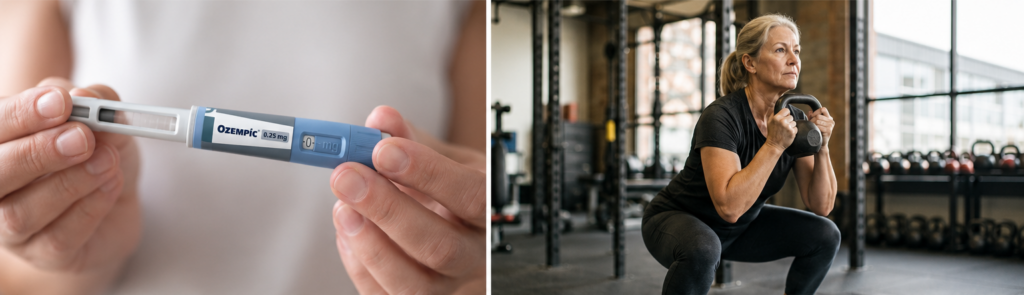
Peptides have become one of the biggest topics in healthcare, the media and everyday conversation. From celebrities and social media influencers to medical research, there is growing discussion around medications such as Ozempic®, Wegovy®, Mounjaro® and Saxenda®. There is also increasing interest in a range of other peptide therapies, although those fall outside the scope of this article. Here, we focus on why resistance training while taking GLP-1 medications is so important for long-term health.
Originally, GLP-1 medications were developed to help manage type 2 diabetes by improving blood sugar control. Researchers soon discovered that these medications also reduced appetite and promoted significant weight loss, leading to their approval for the treatment of obesity in appropriate patients (Davies et al., 2021; Wilding et al., 2021).
For many people, these medications can be an effective part of a comprehensive treatment plan under the guidance of a medical doctor.
Resistance training while taking GLP-1 medications has become an important topic in medical research. Studies using body composition measurements have shown that weight loss during GLP-1 treatment includes both fat mass and lean body mass. While lean body mass includes more than just skeletal muscle, preserving muscle remains a key priority for maintaining strength, mobility and long-term metabolic health. Progressive resistance training, together with adequate nutrition, is now recognised as an essential component of successful GLP-1 therapy (Mechanick et al., 2025; ACSM, 2022).
Body Composition Matters More Than Body Weight
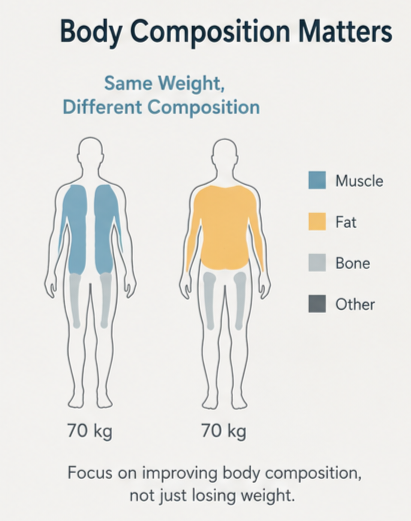
One of the biggest shifts in health and fitness is the move away from focusing purely on weight towards improving body composition.
Body composition refers to the proportion of body fat, muscle, bone and water that makes up your body. Two people can weigh exactly the same but have very different body compositions, resulting in significant differences in strength, mobility, metabolic health and overall wellbeing.
The goal of healthy weight loss isn’t simply to lose kilograms. It’s to reduce excess body fat while preserving as much muscle as possible.
Why Preserving Muscle Is Essential
Muscle is one of the body’s most valuable tissues. It plays a critical role in:
- Strength and mobility
- Supporting and protecting joints
- Improving balance and reducing falls
- Maintaining metabolic health
- Blood sugar regulation
- Healthy ageing and independence
Maintaining muscle during weight loss helps preserve physical function, supports resting metabolic rate and contributes to better long-term health outcomes (Wolfe, 2006; Crawford et al., 2026).
Resistance Training while taking GLP-1: The Missing Piece
Current evidence consistently shows that progressive resistance training is one of the most effective ways to preserve muscle while losing weight. Combined with adequate protein intake, resistance training helps improve body composition, maintain strength and support long-term health (ACSM, 2022; Morton et al., 2018).
Research favours progressively increasing resistance over time to provide sufficient stimulus for maintaining and building muscle. This doesn’t mean everyone should begin with heavy weights, but it does mean that your exercise programme should progress as your strength improves.
How Physiotherapy Can Help
Starting a resistance training programme can be challenging, especially if you’re recovering from an injury, living with pain or haven’t exercised in years.

A physiotherapist can assess your strength, mobility and movement patterns before designing an individualised programme that is safe, progressive and aligned with your goals.
For many people, Clinical Pilates provides an excellent starting point. It improves movement quality, body awareness, control and foundational strength, creating the confidence and physical capacity to progress towards heavier resistance training where appropriate.
A Team Approach Delivers the Best Results

GLP-1 medications work best as part of a comprehensive healthcare plan.
Your healthcare team may include:
- A medical doctor to prescribe and monitor your medication.
- A physiotherapist to guide your resistance training, improve movement and help preserve muscle throughout your weight-loss journey. We can help – contact us today!
- A registered dietitian to help you meet your protein and nutritional requirements, supporting muscle preservation and overall health despite a reduced appetite. (Contact Izette Faul Dieticians today!)
Working together, this multidisciplinary approach helps maximise the health benefits of GLP-1 therapy while reducing the risk of unnecessary muscle loss.
Start Your GLP-1 Resistance Training Journey with Just Physio
GLP-1 medications have transformed weight management, but they are only one part of the picture.
The greatest long-term benefits come from improving body composition, not simply losing weight. Preserving muscle through progressive resistance training will help you stay stronger, move better and maintain your results well into the future.
At Just Physio, we help people build strength safely through personalised physiotherapy, progressive resistance training programmes and Clinical Pilates, providing a strong foundation for lifelong movement and health.
If you’re using a GLP-1 medication and want to preserve muscle, improve your body composition and start an effective resistance training programme, contact Just Physio today to book a physiotherapy assessment or find out more about our Clinical Pilates classes.
References
American College of Sports Medicine. (2022). ACSM’s Guidelines for Exercise Testing and Prescription (11th ed.). Wolters Kluwer.
Crawford, J., et al. (2026). Lean Mass and Musculoskeletal Preservation in GLP-1-Based Obesity Treatment: Nutrition, Exercise, Supplementation, and Monitoring Strategies. Nutrients.
Davies, M., Færch, L., Jeppesen, O. K., et al. (2021). Semaglutide 2.4 mg once a week in adults with overweight or obesity, and type 2 diabetes (STEP 2): A randomised, double-blind, double-dummy, placebo-controlled, phase 3 trial. The Lancet, 397(10278), 971–984. https://doi.org/10.1016/S0140-6736(21)00213-0
Mechanick, J. I., Butsch, W. S., Christensen, S. M., Hamdy, O., Li, Z., Prado, C. M., Heymsfield, S. B., et al. (2025). Strategies for minimizing muscle loss during use of incretin-mimetic drugs for treatment of obesity. Obesity Reviews, 26(1), e13841. https://doi.org/10.1111/obr.13841
Morton, R. W., Murphy, K. T., McKellar, S. R., et al. (2018). A systematic review, meta-analysis and meta-regression of the effect of protein supplementation on resistance training-induced gains in muscle mass and strength in healthy adults. British Journal of Sports Medicine, 52(6), 376–384.
Wilding, J. P. H., Batterham, R. L., Calanna, S., et al. (2021). Once-weekly semaglutide in adults with overweight or obesity. The New England Journal of Medicine, 384(11), 989–1002. https://doi.org/10.1056/NEJMoa2032183
Wolfe, R. R. (2006). The underappreciated role of muscle in health and disease. The American Journal of Clinical Nutrition, 84(3), 475–482.

